
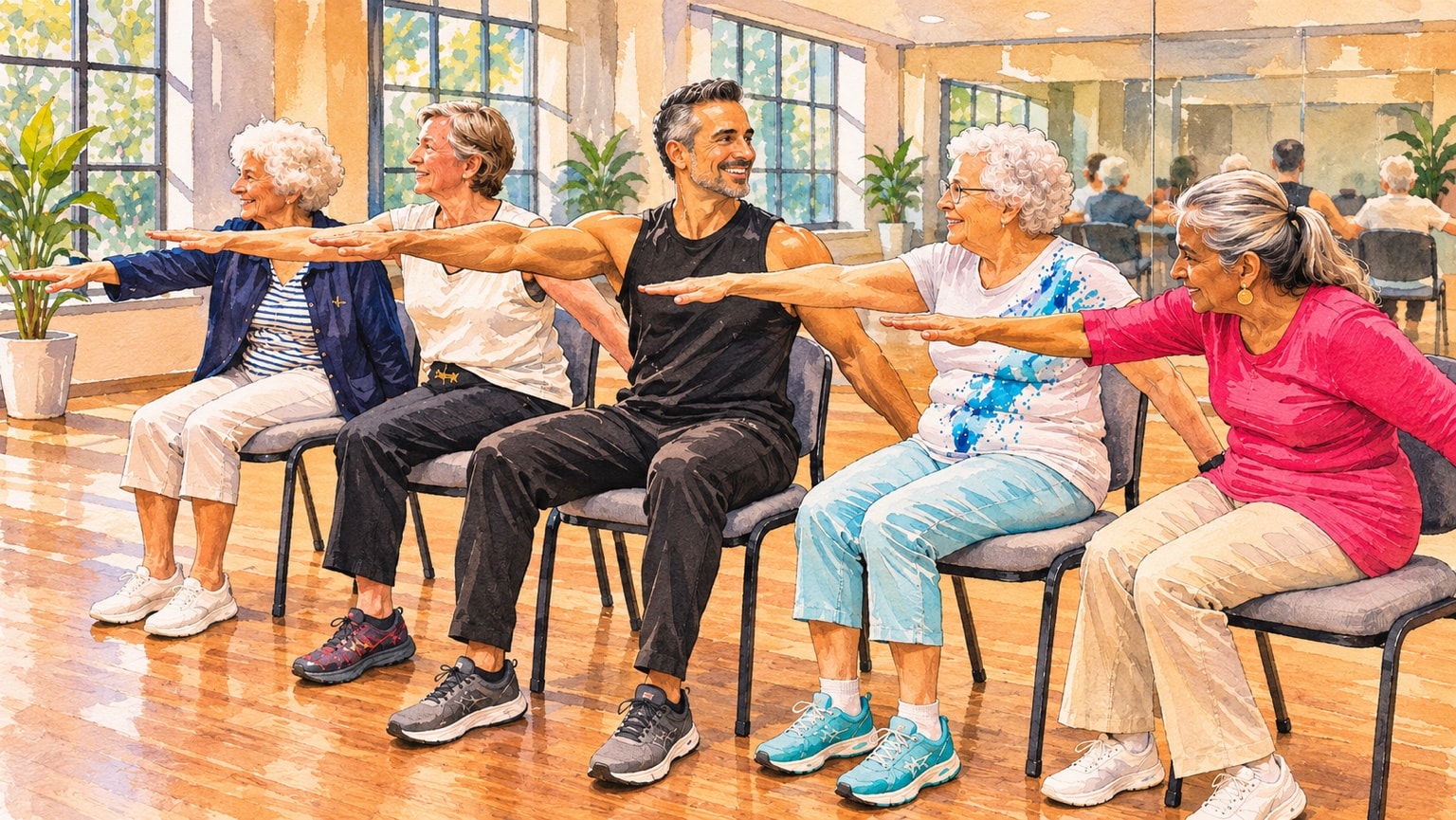
Staying active is one of the most important things we can do as we age. Yet traditional exercise programs aren't always comfortable or accessible for everyone. Getting down onto a yoga mat, maintaining standing poses, or keeping up with a fast-paced class can present challenges.
Chair yoga offers a welcoming alternative.
By adapting traditional yoga postures to a seated position or using a sturdy chair for support, participants can experience mindful movement without needing to get down onto the floor.
And while the movements may appear simple, there's much more to chair yoga than stretching.
Staying Strong, Steady, and Independent
For older adults, maintaining balance isn't simply about staying active. It's about preserving the confidence and independence to navigate everyday life.
Falls are a significant concern as we age. According to the Centers for Disease Control and Prevention, more than one in four adults age 65 and older experiences a fall each year.
Muscle weakness, particularly in the legs and lower body, and difficulties with balance and walking are recognized risk factors. Core strength also helps support posture and stability during movement. Limited mobility can make certain everyday activities more challenging.
Think about the actions we often take for granted: rising from a chair, reaching into a cabinet, turning to look behind us, or stepping around an obstacle. Each requires a combination of strength, coordination, balance, and mobility.
Chair yoga offers an accessible way to work on several of these abilities.
Through controlled movements, gentle stretching, and attention to posture, participants can engage muscles involved in everyday activities. Depending on individual abilities, chair yoga classes may also incorporate supported standing exercises that challenge balance.
Research suggests that yoga can improve certain measures of balance, strength, and physical function in older adults. Although evidence that chair yoga itself reduces the number of falls remains limited, it can complement a broader fall-prevention approach that includes strength and balance training.
Falls have many potential causes, including medications, vision difficulties, and environmental hazards. No single exercise program can eliminate every risk.
The goal is to maintain the physical abilities that help us move through life with greater stability, confidence, and independence.
Adults age 65+ experience a fall annually.
Source: CDC
Supporting Flexibility and Everyday Mobility
Comfortable movement plays an important role in daily living.
Reaching overhead, turning the upper body, getting dressed, and bending to pick something up all depend on mobility and coordination.
As we age, muscles and connective tissues can become less pliable, and joints may lose some of their range of motion. This can make everyday tasks feel more effortful.
Chair yoga incorporates gentle stretching and range-of-motion movements that work through the major joints of the body — the shoulders, hips, spine, and ankles.
Over time, consistent practice may help maintain or gradually improve flexibility and ease of movement. Research suggests that yoga can support flexibility and mobility in older adults, though individual results vary.
The goal isn't to achieve a particular range of motion. It's to keep the body moving comfortably and to preserve the ease of everyday activities.
The Mind-Body Connection
Yoga has always been more than a physical practice.
The intentional pairing of breath with movement is central to the practice. In chair yoga, participants are guided to coordinate their breathing with each posture — inhaling as they reach or expand, exhaling as they fold or release.
This breath awareness can help bring attention to the present moment, encouraging a quality of mindfulness that extends beyond the class itself.
Research on yoga and older adults suggests potential benefits for mood, stress, and overall sense of well-being, though more research specific to chair yoga is needed. Many participants simply report feeling calmer, more centered, and more at ease in their bodies after class.
That sense of ease — of feeling more comfortable in one's own body — is itself a meaningful outcome.
Three Poses to Try
The following three poses form the foundation of a gentle seated Vinyasa sequence. Each can be practiced on its own or linked together as a flowing practice.
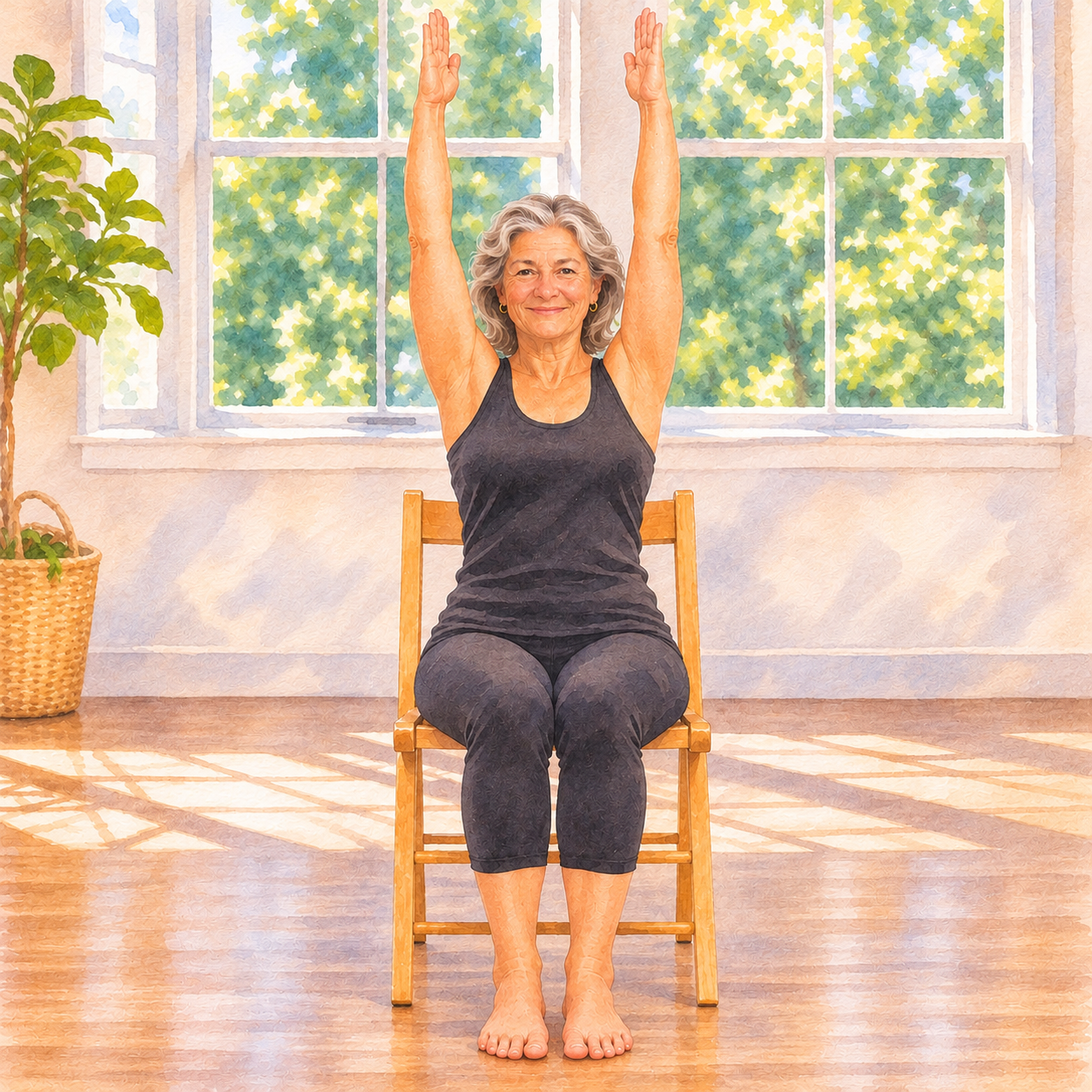
Pose 01
Volcano Pose
Urdhva Hastasana
Reach upward, lengthen the spine, and encourage shoulder mobility.
Begin seated tall with your palms pressed together at heart center.
Inhale as you gracefully sweep your arms overhead, allowing your hands to separate to shoulder-width apart. If comfortable, let your gaze follow your hands.
Exhale as you slowly bring your palms together and lower your hands to heart center.
Repeat several times, allowing your breath to guide the movement.
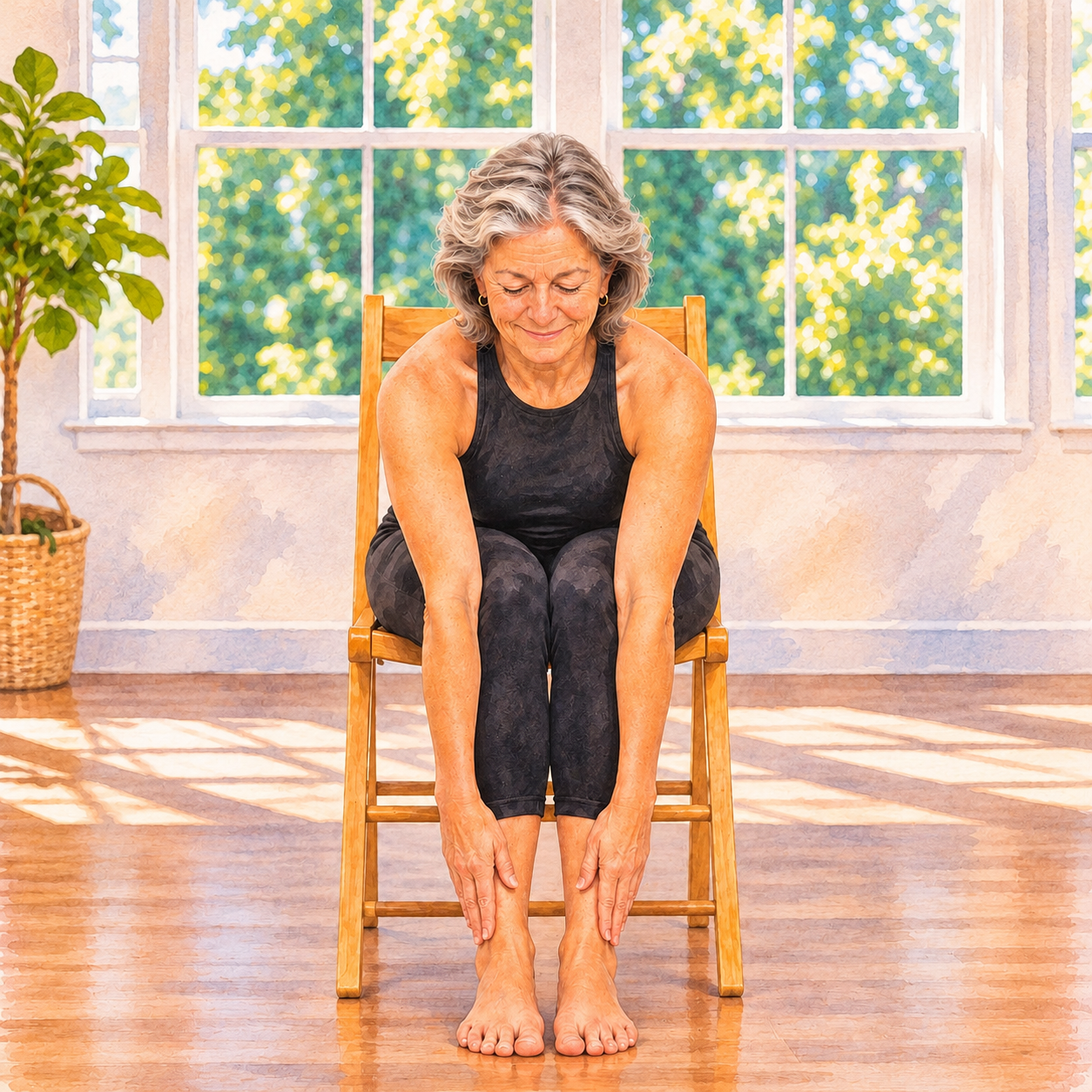
Pose 02
Seated Forward Fold
Adapted Uttanasana
Encourage flexibility, mobility, and body awareness.
Begin seated tall with your arms extended overhead.
As you exhale, gracefully swan dive your arms out to the sides and down toward your legs, gently hinging forward from your hips.
Allow your hands to travel down your legs only as far as feels comfortable, keeping your spine comfortably long.
Inhale as you slowly return upright, sweeping your arms out to the sides and overhead in one fluid movement.
Repeat several times, coordinating each movement with your breath.
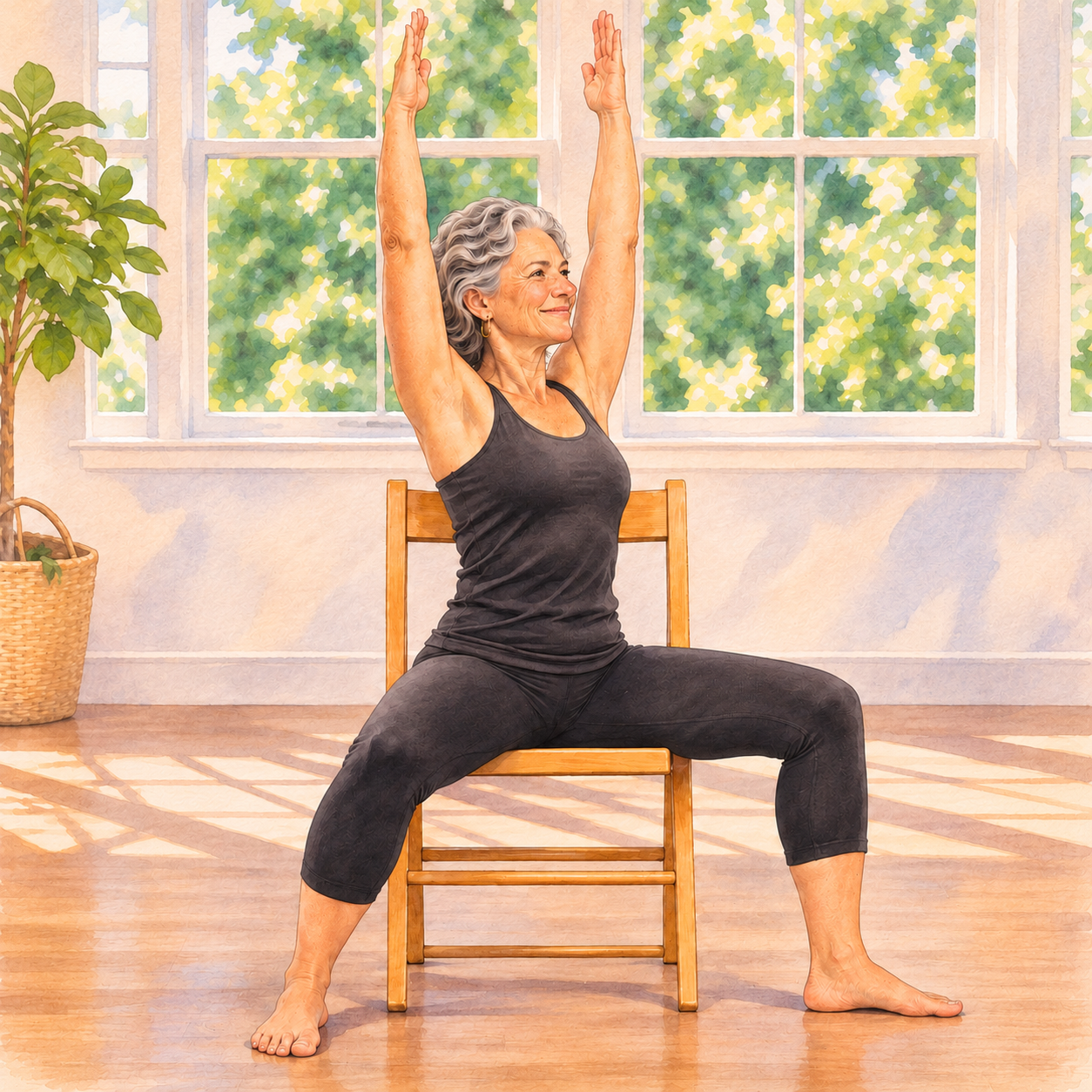
Pose 03
Seated Warrior I
Adapted Virabhadrasana I
Encourage postural strength, stability, and coordinated movement.
Begin in a neutral seated position, with your arms extended overhead, shoulder-width apart, maintaining secure contact with the chair.
If comfortable, gently turn your torso and shoulders to one side, positioning one foot forward while extending the opposite leg back within a comfortable range.
Keep your spine long and your shoulders relaxed as you reach upward through your arms.
Hold for two or three comfortable breaths.
Gently return your torso to center, bringing your legs back to a comfortable seated position while keeping your arms extended overhead in Volcano Pose.
Exhale as you lower your arms, returning to a neutral seated position.
Bring It All Together: A Gentle Seated Vinyasa
Begin with your palms together at heart center. Inhale into Volcano Pose, sweeping your arms overhead.
As you exhale, gracefully swan dive your arms out to the sides and down toward your legs, gently folding forward from your hips into a Seated Forward Fold.
Inhale as you return upright, sweeping your arms overhead, then gently turn your torso and shoulders to one side, transitioning into Seated Warrior I.
Return to Volcano Pose, bringing your torso back to center with your arms extended overhead, shoulder-width apart. Exhale as you bring your palms together and lower your hands to heart center.
Repeat on the opposite side, allowing your breath to guide each movement in a comfortable, flowing rhythm.
Like a dance, each movement flows naturally into the next — connecting breath, body, and mind.
More Than Exercise: The Value of Connection
One of the most meaningful aspects of chair yoga may have little to do with the poses themselves.
Group classes create opportunities for conversation, friendship, and shared experiences.
For older adults living in senior communities or participating in neighborhood wellness programs, a familiar class can become an enjoyable part of the weekly routine.
A welcoming instructor, familiar faces, and the simple pleasure of moving together can help make participation something to look forward to.
Movement for Every Body
At Age Well Recreation, we believe that meaningful movement should remain accessible throughout the aging journey.
Our instructors bring adaptive, yoga-based wellness experiences to senior living communities, memory care settings, and community-based wellness programs throughout NY.
Whether someone is discovering yoga for the first time or returning to a familiar practice, the emphasis is on meeting each participant where they are.
Successful movement isn't measured by how far someone can stretch or how perfectly they perform a pose.
It's about participation, consistency, and finding enjoyment in what the body can do.
You don't have to be flexible to practice yoga. You simply have to begin where you are.
A Gentle Reminder
Every body is different. Move at your own pace, keep your breathing comfortable, and skip any movement that causes pain, dizziness, or discomfort. If you have a medical condition, recent injury, or concerns about your mobility, check with your healthcare professional and let your instructor know. Some movements, especially forward bending, may need modification.
This article is intended for general wellness education and is not a substitute for individualized medical advice.
References
- Centers for Disease Control and Prevention. Older Adult Falls Data.
- National Center for Complementary and Integrative Health. Yoga: Effectiveness and Safety.
- Loewenthal J, et al. Effect of Yoga on Frailty in Older Adults: A Systematic Review. Annals of Internal Medicine, 2023.
- Sivaramakrishnan D, et al. The Effects of Yoga Compared to Active and Inactive Controls on Physical Function and Health-Related Quality of Life in Older Adults. International Journal of Behavioral Nutrition and Physical Activity, 2019.
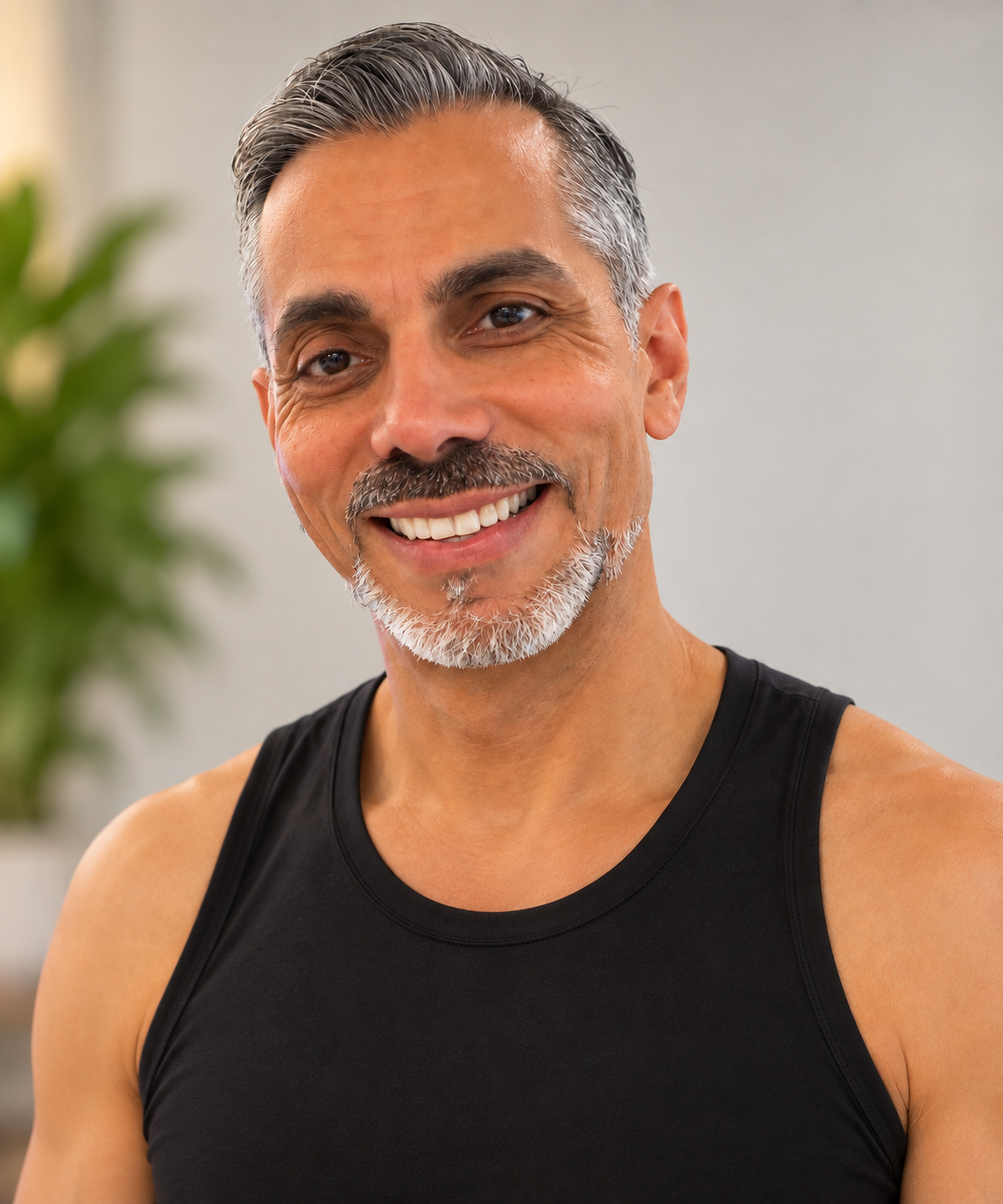
Ray Torres
Registered Yoga Teacher · Certified Dementia Practitioner
Ray Torres is the Founder of Age Well Recreation and the Editorial Director of Wellness Insights. A Registered Yoga Teacher and Certified Dementia Practitioner, he brings adaptive wellness programming to senior living communities, memory care settings, and community-based programs throughout New York.
Read full bio